
01 · World Thrombosis Day
Not every stroke is arterial
World Thrombosis Day on 13 October is an opportunity to recognise blood clots wherever they occur. Cerebral venous thrombosis (CVT), also called cerebral venous sinus thrombosis, is less common than arterial ischaemic stroke but can affect young adults, pregnant or postpartum women and people without traditional arterial risk factors.
Symptoms may evolve over hours or days and can initially resemble migraine, infection or another neurological disorder. Early venous imaging and anticoagulant treatment can change the course of the disease.
02 · Evidence in numbers
The burden is global; the presentation can be easy to miss
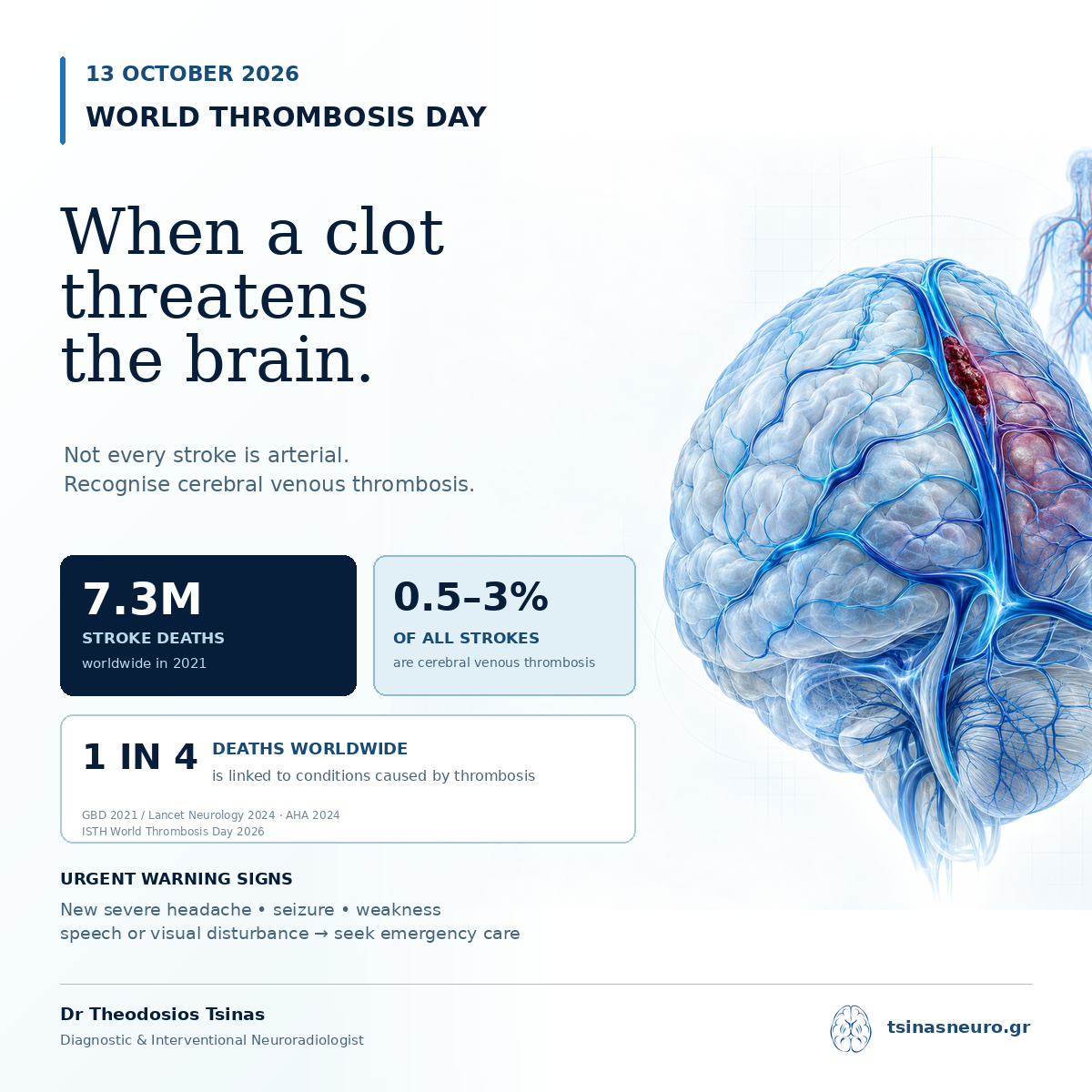
The Global Burden of Disease 2021 study estimated 7.3 million deaths from stroke worldwide in 2021. The ISTH World Thrombosis Day campaign reports that conditions related to thrombosis contribute to one in four deaths globally.
CVT represents approximately 0.5–3% of all strokes. Although uncommon, it disproportionately affects younger people and women of childbearing potential, so awareness and the correct venous imaging pathway matter.
03 · Recognition
Symptoms and emergency warning signs
Headache is the most frequent symptom. It may be new, unusual, progressively worsening or different from a person’s usual migraine. Some patients have isolated headache; others develop signs of raised intracranial pressure or focal brain dysfunction.
- New persistent or rapidly worsening headache
- A first seizure or repeated seizures
- Weakness, numbness, speech difficulty, imbalance or confusion
- Blurred or double vision, or brief visual blackouts
- Repeated vomiting, marked drowsiness or loss of consciousness
- A sudden thunderclap headache
04 · Risk profile
Risk factors change across life
CVT often reflects several temporary and personal factors. Pregnancy and especially the postpartum period, oestrogen-containing contraception or hormone therapy, cancer, serious infection, inflammatory or autoimmune disease, dehydration, surgery, trauma and prolonged immobility can increase risk. Blood disorders and inherited or acquired thrombophilia may also contribute.
Women’s thrombotic risk changes across reproductive life and menopause. This does not mean that contraception, fertility treatment or hormone replacement should be stopped automatically. The safest decision is individual and balances clotting risk with the reason for treatment.
05 · Targeted testing
Thrombophilia screening is not one-size-fits-all
A broad thrombophilia panel is not routinely useful for every patient. The acute clot and anticoagulant treatment can alter some test results. Testing is more likely to be considered in a younger person with apparently unprovoked CVT, recurrent venous clots, a strong family history or when the result would change the type or duration of treatment.
The treating team should select the tests and their timing. Evaluation for other underlying conditions is also guided by history, examination and age rather than indiscriminate screening.
06 · Neuroimaging
CT venography, MRI and MR venography
Unenhanced CT is often the first emergency scan because it is fast and can identify haemorrhage, swelling or another cause. A normal unenhanced CT does not exclude CVT. CT venography (CTV) assesses the dural sinuses and major cerebral veins directly.
MRI shows brain tissue, thrombus evolution, venous oedema and infarction in greater detail. MR venography (MRV) evaluates venous flow and filling. Anatomical variants and slow flow can mimic occlusion, so the source images and clinical context matter. Catheter angiography is reserved for selected inconclusive cases or endovascular planning.

07 · Treatment & recovery
Anticoagulation first; intervention for selected cases
Anticoagulation is the cornerstone of acute treatment for most patients, including many with a small haemorrhagic venous infarction. It prevents extension of the clot while the body recanalises the vein. The team also treats seizures, infection or another trigger and manages raised intracranial pressure.
Endovascular thrombectomy or local thrombolysis is not routine first-line therapy. It may be considered at an experienced centre for carefully selected patients who deteriorate despite appropriate treatment or have a severe high-risk presentation. Decompressive surgery can be life-saving when extensive swelling threatens herniation.
The duration of anticoagulation and follow-up are individual. Many people recover well, although fatigue, headache, mood symptoms or cognitive difficulties may persist and benefit from rehabilitation.
08 · Evidence