01 · Awareness
Real voices, real change
World Mental Health Day is observed every 10 October to encourage open discussion, reduce stigma and improve access to appropriate care. The 2026 WHO campaign centres on lived experience: ‘Real voices, real change.’
More than one billion people worldwide live with a mental health condition. These conditions emerge through a complex interaction of biological, psychological, social and environmental factors. No single factor—and no single image—captures the whole person.
02 · Clinical reality
Can an MRI diagnose a mental health condition?
In most cases, no CT, MRI or isolated imaging pattern can independently diagnose depression, anxiety, bipolar disorder, schizophrenia, post-traumatic stress disorder or another primary psychiatric condition. Diagnosis is based on the person's symptoms and lived experience, medical and psychological history, duration and effect of symptoms, mental-state and neurological examination, medicines, substances, sleep and social context.
A normal MRI does not mean that symptoms are imaginary. Mental health conditions can significantly affect brain function without producing a structural abnormality visible on a routine clinical scan.
03 · When imaging helps
Looking for neurological or medical causes
Imaging becomes particularly valuable when the clinical team needs to determine whether a neurological or medical condition could be contributing to a change in mood, behaviour, cognition or perception.
- Sudden, rapidly progressive or atypical symptoms
- First symptoms at an unusual age
- Seizures, collapse or altered awareness
- Focal weakness, sensory loss, speech disturbance or imbalance
- Persistent unusual headache, cognitive decline or major personality change
- Recent head injury, fever, immunosuppression, cancer or an abnormal neurological examination
04 · First-episode psychosis
Why the decision is individual
The role of routine MRI in first-episode psychosis remains scientifically debated. NICE does not recommend structural CT or MRI as a routine investigation for every person with first-episode psychosis when there are no additional signs of neurological disease.
A 2023 systematic review and meta-analysis nevertheless reported a clinically relevant MRI finding in approximately 5.9% of patients with first-episode psychosis. The choice should therefore be individual, considering age, symptom pattern, neurological findings and the consequences of missing a treatable condition.
05 · Imaging science
What advanced imaging is teaching us
Structural MRI, diffusion imaging, functional MRI, perfusion, MR spectroscopy and PET have revealed group-level differences in brain anatomy, connectivity, blood flow and metabolism across several psychiatric conditions. These methods are helping researchers study networks involved in emotion, memory, motivation, attention and cognitive control.
However, there is substantial overlap between different diagnoses and between affected people and healthy volunteers. Most proposed imaging biomarkers are not yet sufficiently accurate, reproducible or standardised to diagnose an individual patient or select treatment independently. Their main present value remains research and the development of future personalised approaches.
06 · Person-centred care
The scan is never the whole person
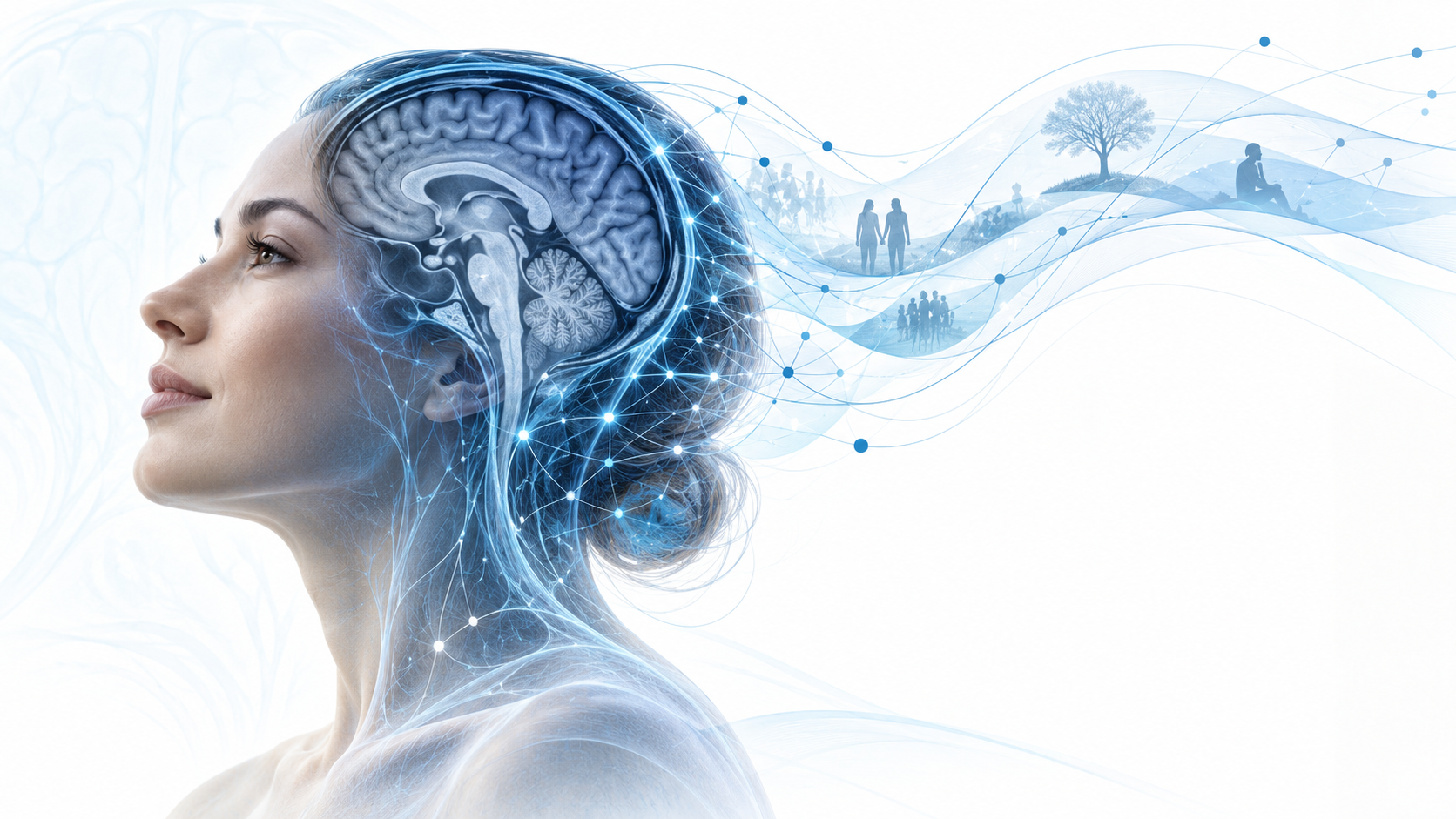
Neuroimaging may provide valuable biological information, but it cannot measure personal suffering, trauma, loneliness, relationships, resilience or quality of life. It does not replace psychiatric assessment, psychological support or community care.
Responsible imaging uses an appropriate indication, a tailored protocol and interpretation within the complete clinical context. Incidental or non-specific findings should be communicated carefully: a small MRI variation does not automatically explain psychological symptoms, predict future illness or define a person's identity.
07 · Evidence