01 · World Stroke Day
Every M1nute Counts
World Stroke Day is marked on 29 October. The 2026 World Stroke Organization campaign focuses on symptom awareness and the need to #ActFAST: stroke can happen without warning, and early emergency care can save life and brain function.
A stroke occurs when blood flow to part of the brain is blocked or when a vessel ruptures. Symptoms depend on the affected brain region and may be painless. Never wait to see whether they disappear.
02 · Recognition
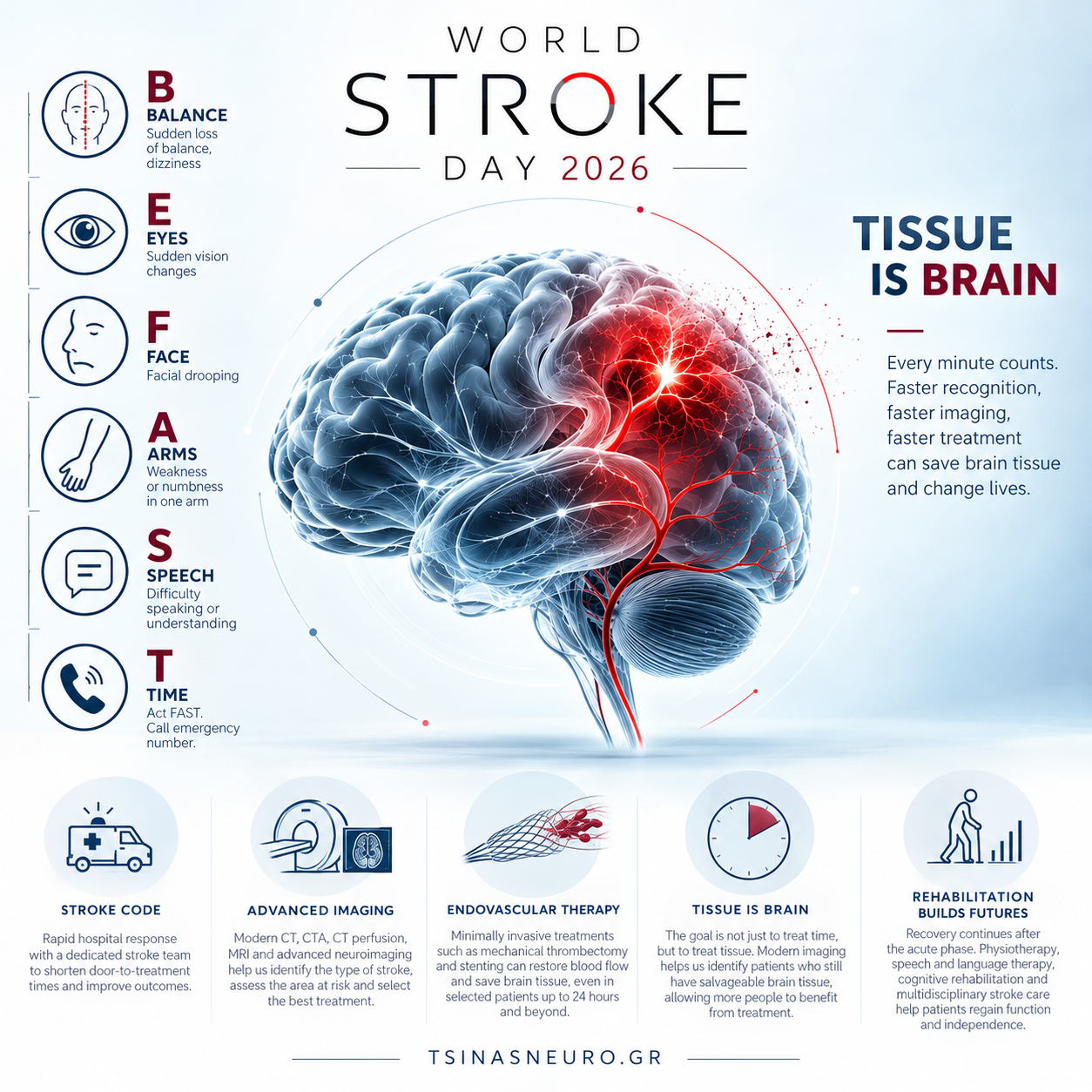
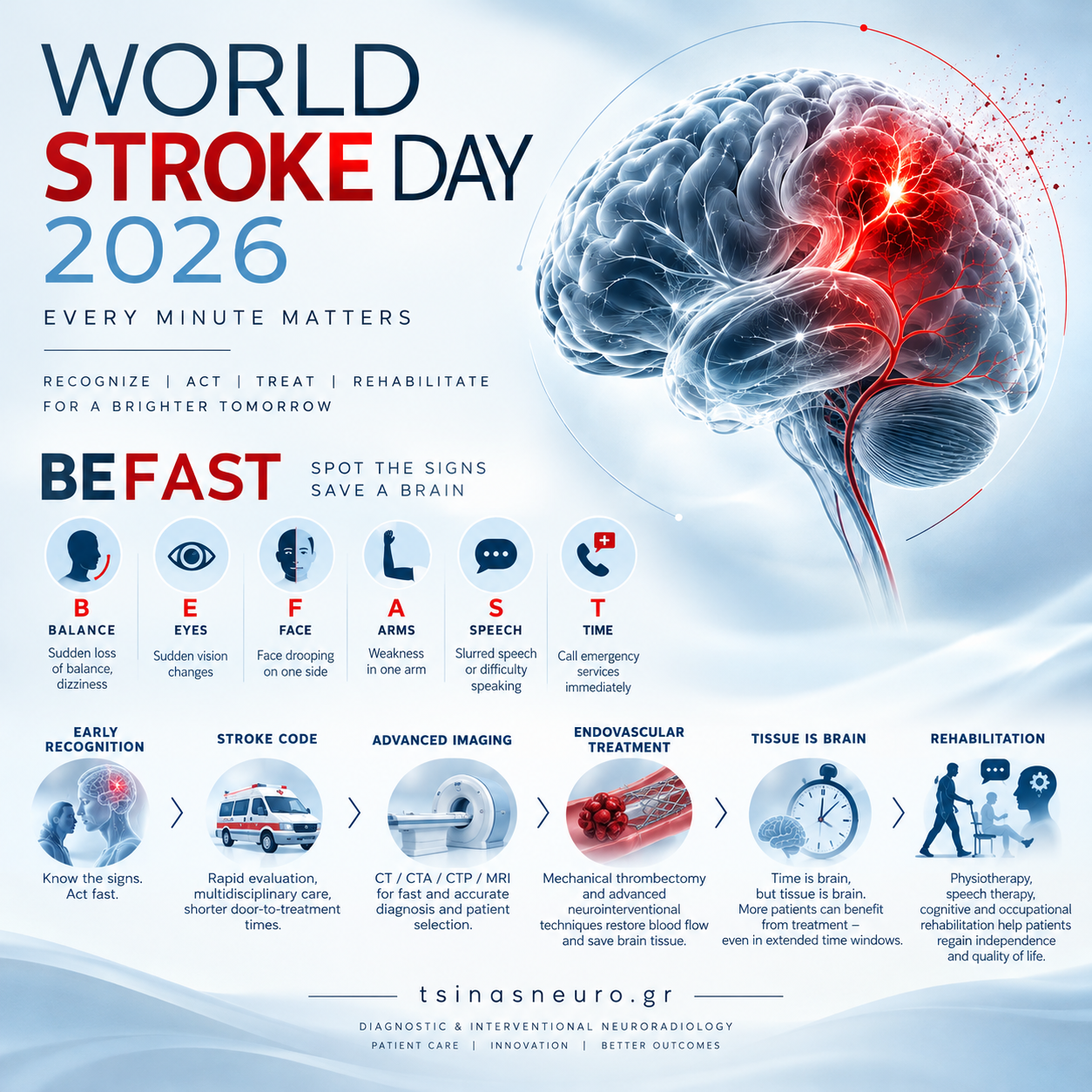
BEFAST: spot the signs, save a brain
BEFAST extends the familiar FAST message to include posterior-circulation symptoms. Even one sudden sign is enough to trigger an emergency response.
- B · Balance: sudden dizziness, loss of balance, coordination or ability to walk
- E · Eyes: sudden loss, blurring or doubling of vision
- F · Face: one side droops or feels numb
- A · Arms: weakness or numbness of one arm or leg
- S · Speech: slurred speech, wrong words, inability to speak or understand
- T · Time: call emergency services immediately
03 · Hospital response
The Stroke Code shortens door-to-treatment time
The emergency team checks airway, oxygenation, circulation, blood glucose, medicines, time last known well and the neurological deficit. A coordinated Stroke Code alerts neurology, neuroradiology, emergency medicine, nursing, laboratory and the angiography team in parallel.
The goal is not simply to complete tests—it is to identify the type of stroke and the safest effective treatment as rapidly as possible.
04 · Advanced neuroimaging
CT, CTA and perfusion answer different questions
Non-contrast CT rapidly excludes intracranial haemorrhage and estimates early ischaemic change. CT angiography of the head and neck identifies a large-vessel occlusion, stenosis, dissection or aneurysmal source and maps the access route for treatment.
CT perfusion or MRI can estimate irreversibly injured core and potentially salvageable penumbra in selected patients, including wake-up or late-window stroke. Advanced imaging should support fast decisions and must not delay treatment that is already indicated.
05 · Reperfusion therapy
Intravenous thrombolysis and mechanical thrombectomy
Eligible patients with disabling acute ischaemic stroke may receive intravenous alteplase or tenecteplase, usually within 4.5 hours. Selected patients with unknown onset or 4.5–9 hours may also qualify using advanced imaging criteria.
Mechanical thrombectomy removes a clot from a large intracranial artery using aspiration, a stent retriever or both. It is standard treatment for suitable large-vessel occlusions and can benefit carefully selected patients up to 24 hours, including some patients with a larger ischaemic core or basilar artery occlusion. When both thrombolysis and thrombectomy are indicated, thrombectomy should not be delayed to wait for improvement.
06 · Modern selection
Time is brain—but tissue is brain
Every minute without reperfusion can cost viable brain, so speed always matters. Yet people lose tissue at different rates depending on collateral circulation, occlusion site and physiology.
The tissue-based model uses clinical findings and imaging to identify patients who still have salvageable brain despite a late presentation. It expands treatment opportunities; it does not make delay safe. The best outcome still comes from recognizing symptoms and reaching an appropriate stroke centre immediately.
07 · After reperfusion
Dedicated Stroke Unit care continues the treatment
Reopening an artery is the beginning of the next phase. Specialist monitoring detects haemorrhage, swelling, recurrent stroke, rhythm disturbance, blood-pressure problems, fever, glucose disturbance and swallowing difficulty.
Secondary prevention is tailored to the cause and may include antithrombotic treatment, management of atrial fibrillation, carotid disease, blood pressure, diabetes, cholesterol, smoking and lifestyle. Follow-up imaging is selected when it can change care.
08 · Recovery
Rehabilitation builds the path back to independence
Rehabilitation should begin as soon as the patient is medically stable. Physiotherapy supports movement, strength and balance; occupational therapy restores daily activities; speech and language therapy addresses communication and swallowing; cognitive and psychological care supports memory, attention, mood and adjustment.
Recovery is individual and can continue for months or years. Family education, realistic goals, prevention of complications and coordinated community follow-up are part of modern stroke care—not optional extras.
09 · Evidence